

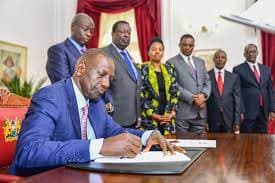
In a momentous move that is set to recalibrate Kenya’s financial landscape, President William Ruto has officially signed the much-debated Finance Bill into law. The bill was green-lighted by the National Assembly in the preceding week amidst a maelstrom of criticism and controversy, with a significant portion of the Opposition choosing to abstain from the proceedings.
The ceremonious signing took place at the State House, Nairobi, on a clear Monday morning, as confirmed by Emmanuel Talam, the Press Secretary of the State House. “President William Ruto has given his assent to the Finance Bill,” announced Talam.
The Finance Bill, which has raised more than its fair share of eyebrows, has been designed with the primary objective of augmenting the government’s revenue through additional taxes. It is expected to generate an estimated Ksh130 billion, earmarked for funding the Kenya Kwanza administration’s ambitious Ksh3.6 trillion budget for the fiscal year 2023/24.
President Ruto asserts that the newly enacted tax law will empower his administration to honour the commitments pledged in their manifesto to the Kenyan people, whilst simultaneously reducing the country’s heavy reliance on foreign debt.



One of the major bones of contention in the bill relates to the housing levy. The newly ratified law has reduced this levy to 1.5 percent of gross pay, down from its initial standing at 3 percent. This mandates employers to transfer a 1.5 percent housing levy deducted from employees’ salaries to the government within a stipulated timeline of nine days. This revenue will be channelled towards financing the affordable housing scheme.
In addition, employers are obligated to make their respective top-ups within the same nine-day window. Failure to comply with these requirements will result in a penalty, calculated as two percent of the unpaid funds for each month of delay.
Your brand here. Reach a focused African audience.
Partner with Anttention Media Africa across high-trust business and tech reporting.
Advertise with usHowever, the enactment of the bill is not all rosy for Kenyans, as they are bracing themselves for a higher cost of living. This is primarily due to the bill’s increase of the Value Added Tax (VAT) on petroleum products from 8 to 16 per cent. The fallout from this move is projected to increase diesel and super petrol prices by over Sh12 per litre. As a result, the cost of super petrol could potentially climb to Sh200 per litre.
This increase is set to spill over into other sectors, most notably transportation. Commercial vehicle and bus fares are likely to escalate, hiking the commuting costs for the common citizen and the production costs for players in the logistics sector. The Energy and Petroleum Regulatory Authority (EPRA) is anticipated to announce these new fuel prices in the wake of the bill’s assent.
Another novel aspect of the Finance Bill pertains to digital content creation. Income generated through digital content monetization will now be subject to a 5 percent withholding tax, aligning it with the tax rate for other professional services. The bill categorizes content creators as individuals who offer “entertainment, social, literary, artistic, educational, or any other material electronically,” through a variety of online platforms, including websites and social media networks like Facebook, Twitter, or Instagram.
Despite the government’s attempt to streamline taxation, several content creators have expressed their disapproval of the plan to raise the tax to 15 percent, arguing that it will suppress the growth of the creative industry.
Opposition leader Raila Odinga has voiced his vehement disapproval of the bill’s enactment, vowing to spearhead mass protests after a public rally in Kamukunji. This sentiment was echoed by Martha Karua and other leaders of the Azimio Coalition during a press conference on June 22, 2023. The Coalition has also extended an open invitation to all Kenyans to participate in a consultation at the Kamukunji Grounds on June 27, 2023.
The Azimio Coalition, demonstrating a readiness to partner with civil society, is steadfastly pushing their agenda for the welfare of Kenyans. A 14-member bi-partisan team had previously suspended weekly protests to pave the way for dialogue but failed to reach a consensus on contentious issues, reigniting the need for peaceful protests.






Comments (0)
No comments yet. Be the first to share your perspective!