

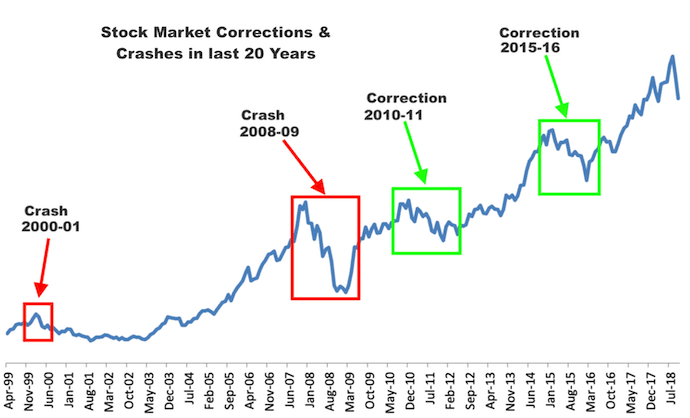
Dante had nine circles of hell in his Inferno, but stock investors have just three, each one progressively worse: a pullback, a correction and a crash. Other than the degree of pain they inflict, these market downdrafts have different characteristics.
Stocks, by their nature, suffer declines, although history shows they gain much more than they lose. Nonetheless, when a market slide materializes, investor fear and even panic, too. It helps to know what you are facing.
Sure, a pullback can morph into a correction and then cascade into a crash. Most times, though, the degree of the market fall is evident pretty early. One key difference among the three classes of market descents is how large the problems were that triggered the drops in the first place.
Pullbacks are dips of 5% to 10% from a recent market high, and are short-term, lasting a month on average and taking another month to retrace the losses, according to a Guggenheim Partners research paper. Pullbacks often result from news events that turn out to be of fleeting important. Look at the last one, in September. The S&P 500 sunk 5.2% amid congressional wrangling over the national debt ceiling, a kerfuffle that got resolved, at least for the moment.



Pullbacks are fairly common, with 84 of them happening since World War II, meaning about one or so per year, with an average loss of 7%.
Because of their short duration, the year when corrections take place very often is positive overall. Since 1974, the S&P 500 has increased an average of around 8% one month after a market correction bottom and more than 24% one year later, the Schwab Center for Financial Research finds.
Your brand here. Reach a focused African audience.
Partner with Anttention Media Africa across high-trust business and tech reporting.
Advertise with usCrashes are downturns of more than 20%. They’re almost always the prelude to a recession. Financial casualties are fierce, as the 2008 demise of venerated Wall Street firm Lehman Brothers shows. Depending on their severity, crashes can last from 11 to 23 months and take up to a maximum five years to climb back. The market’s worst crash came in 1929, with the Dow Jones Industrial Average plunging 70% until its July 1932 trough. The damage was bad enough that the Dow took 25 years, until 1954, to return to its 1929 level.
Crashes typically are born of deep economic crises, often global in scope, such as the 2008 sub-prime mortgage debacle (the S&P 500 fell 57% then) or the pandemic shutdowns (off 34%). The intriguing epilogue to the 2020 crash was that the market recovered very rapidly, hitting new highs, thanks chiefly to a bounteous government stimulus. Since 1946, there have been 12 crashes, with average losses around 35%, and the market can take up to four years to recover.
Market debacles are as inevitable as heat waves. As long as you can afford to ride out the worst times, you can emerge intact or even ahead. After all, even Dante does eventually manage to escape from hell.






Comments (0)
No comments yet. Be the first to share your perspective!